Investment CoursesMiniMax Unveils M2.7 Large Model, AI “Self-Evolution” Sparks Capital Market Attention
On March 18, AI company MiniMax officially launched its next-generation Agent flagship large model, M2.7, showcasing for the first time its “model self-evolution” technology. Boosted by the announcement, the company’s related concept stock, MINIMAX-W (00100.HK), surged sharply during the trading session, with the share price reaching around HKD 1,270 at one point, up more than 22%, and trading volume significantly expanded, making it one of the focus stocks in the Hong Kong market that day.
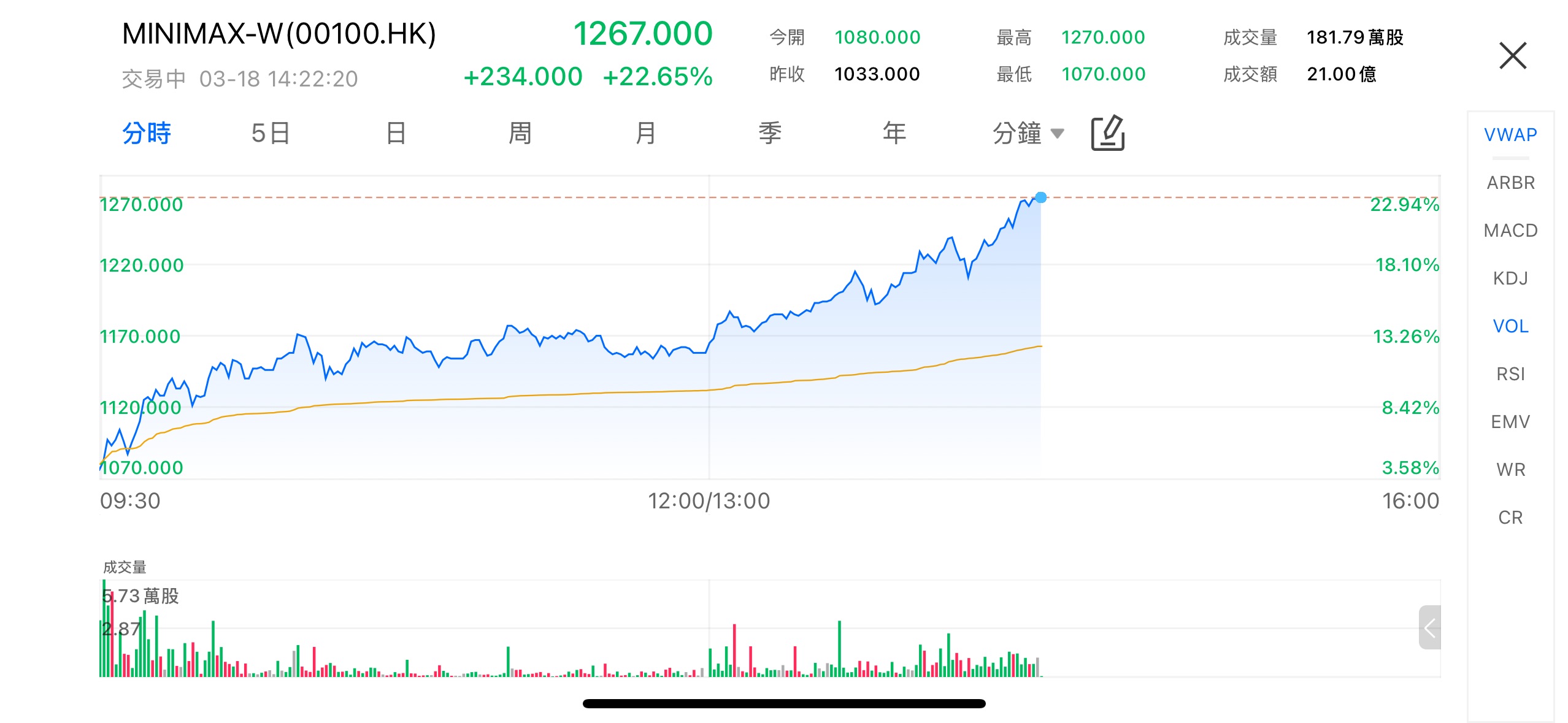
(Image source: uSMART HK app)
“Self-Evolution” Path Realized, Model Participates in Its Own Training
From a technical perspective, the core breakthrough of M2.7 lies in the introduction of the “Agent Harness” framework, which enables the model not only to execute tasks as a tool but also to actively participate in its own training and optimization process. This represents a shift from the traditional reliance on manual labeling and engineering adjustments, allowing AI systems to achieve a certain degree of “self-iteration capability.” According to company disclosures, in certain R&D scenarios, M2.7 can already handle approximately 30%-50% of the workload, significantly improving research efficiency. In internal evaluation systems, its overall performance has increased by about 30% compared with the previous generation, demonstrating substantial performance advancement.
Capital Market Reacts Quickly, Investors Bet on a New AI Paradigm
In terms of market performance, capital has assigned a high premium to this technology path. MINIMAX-W opened higher and continued to climb throughout the trading session, with trading volume expanding in tandem, reflecting strong market interest in the narrative of “AI self-evolution.” The current AI investment logic is shifting from “computing power + model scale” to “efficiency + automation capability.” If a model can participate in its own optimization, it could significantly reduce development costs and accelerate iteration, which is highly significant for industry commercialization.
AI R&D Paradigm May Be at a Turning Point, Industry Competition Accelerates
From an industry perspective, the launch of M2.7 sends a key signal: AI large models are transitioning from “tools being trained” to “autonomous participants.” This trend could have varying impacts on different types of companies. On one hand, leading AI firms with strong algorithmic and engineering capabilities are likely to further expand their technological advantages through automated R&D; on the other hand, application-layer companies relying on external model capabilities may face heightened competitive pressures due to increased technological barriers. Moreover, once the “self-evolution” pathway matures, model iteration speeds could increase exponentially, and the pace of industry competition will accelerate.
From Concept to Implementation Still Needs Validation; Commercialization Path Is Key
Despite high market enthusiasm, some institutions caution that M2.7’s capabilities are currently mainly demonstrated in internal tests and specific scenarios, and large-scale commercial deployment still requires time for verification. In particular, its stability, cost control, and safety in general-use scenarios remain critical variables.Overall, MiniMax’s release represents not only a product upgrade but also a potential shift in the AI development paradigm. With technical breakthroughs aligning with capital expectations, related concepts are likely to maintain high attention in the short term. However, long-term performance will ultimately depend on actual implementation and the pace of commercial realization.
How to Buy MiniMax-W via on uSMART
After logging into the uSMART HK app, click the “Search” button in the top-right corner of the page, enter the ticker code (00100.HK), and navigate to the details page to view transaction details and historical trends. Click the “Trade” button in the bottom-right corner, select the trade type, and submit your order after filling in the transaction conditions.
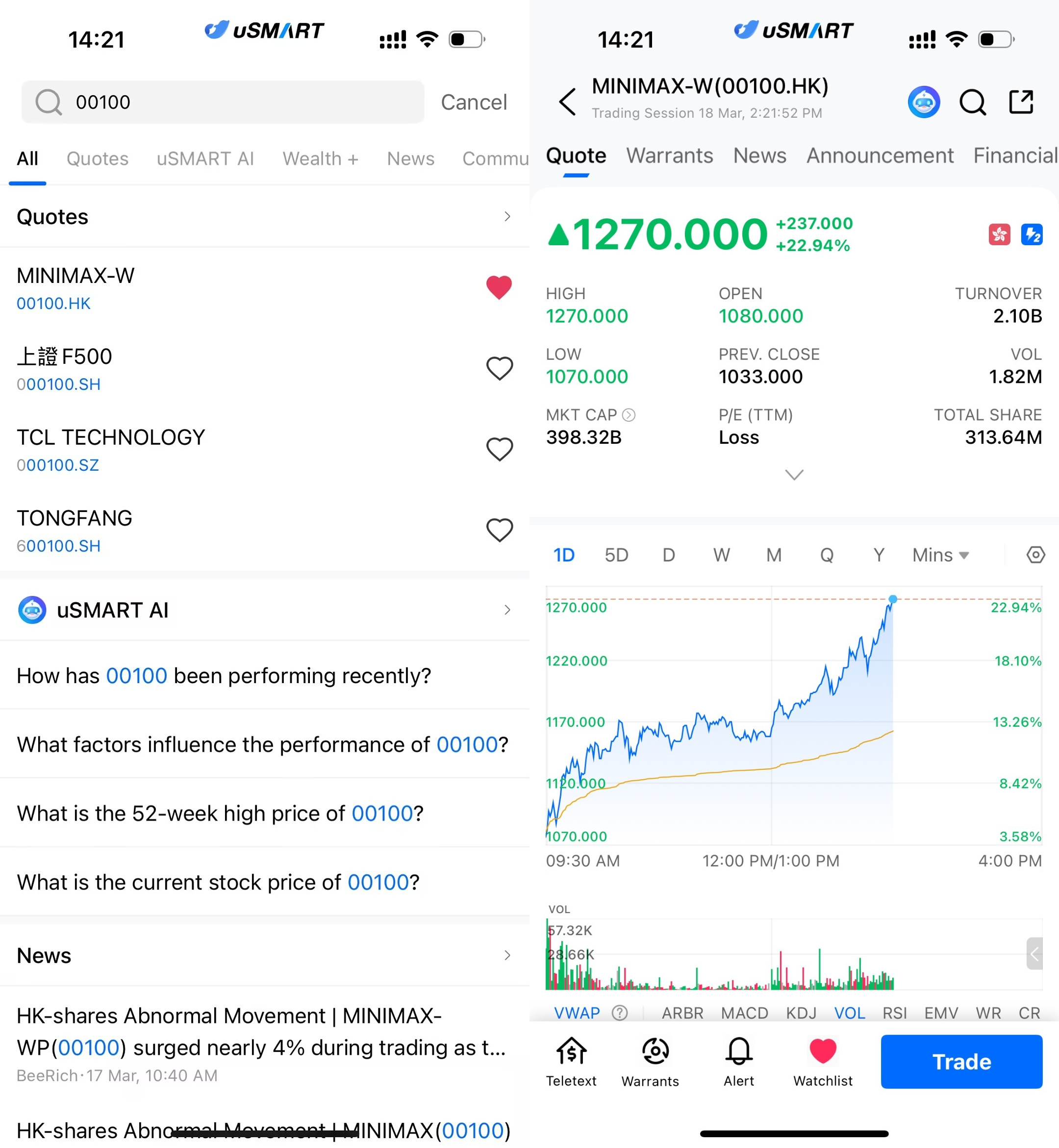
(Image Source: uSMART HK app)


More Content