On March 19, Tencent Holdings (00700.HK) saw its share price fall by more than 6% intraday. Market observers believe this adjustment is not only due to slightly below-expected fourth-quarter 2025 earnings, but also closely related to a shift in the company’s capital allocation strategy.
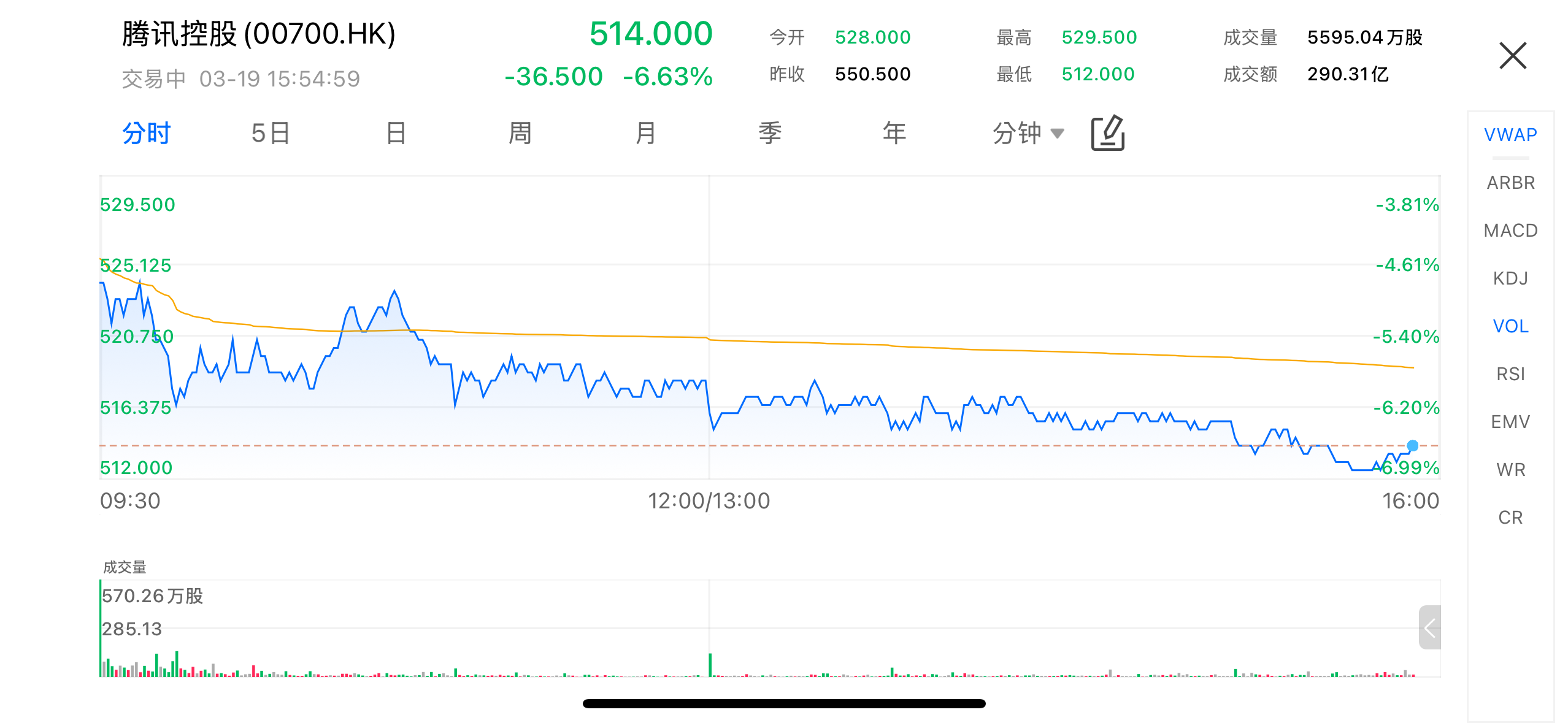 (Image source: uSMART HK app)
Overall Performance Stable, Profit Slightly Misses Expectations
Tencent’s financial report showed that in Q4 2025, the company recorded revenue of RMB 194.37 billion, up 13% year-on-year, slightly above market expectations. Non-IFRS net profit was RMB 64.694 billion, a 17% increase year-on-year, marginally below the market forecast of RMB 64.93 billion.
Overall, the company’s revenue maintained steady growth, reflecting the resilience of its core business. However, in the current market environment where investors place high emphasis on profit quality in internet platforms, the profit slightly missing expectations added pressure on the share price.
Buybacks May Shrink as Capital Allocation Shifts to AI
Beyond the financials, management’s signals on capital allocation drew more attention. Tencent stated that it plans to moderately reduce share repurchases and redirect more funds toward artificial intelligence.
Tencent President Martin Lau noted that due to GPU supply constraints, capital expenditures in the past year fell short of expectations. If conditions improve, future capital expenditures are likely to increase, with a significant rise in AI and large-language model investments. This indicates the company is moving from a phase of “buyback-driven shareholder returns” to “technology investment-driven long-term growth.”
Accelerated AI Investment May Pressure Short-Term Profits
Against the backdrop of global tech companies rapidly expanding in AI, Tencent’s increased investment is strategically necessary. However, early-stage AI projects are capital-intensive with long payback periods, potentially putting short-term pressure on margins. Meanwhile, reduced buyback activity means less direct support for the stock, amplifying the market’s sensitivity to earnings fluctuations.
Valuation Logic Shifts, Market Repricing Underway
Historically, Tencent’s valuation has been built on stable earnings, strong cash flow, and continuous buybacks, offering relatively high predictability. With rising capital expenditures and ongoing strategic transformation, uncertainty has increased, prompting a reevaluation of its valuation framework.
Overall, the recent share price decline largely reflects the market pricing in “reduced short-term certainty” rather than a deterioration in fundamentals. In the medium to long term, whether AI investments can become a new growth engine will be key to reshaping the company’s valuation.
How to Buy Tencent via on uSMART
After logging into the uSMART HK app, click the “Search” button in the top-right corner of the page, enter the ticker code (00700.HK), and navigate to the details page to view transaction details and historical trends. Click the “Trade” button in the bottom-right corner, select the trade type, and submit your order after filling in the transaction conditions.
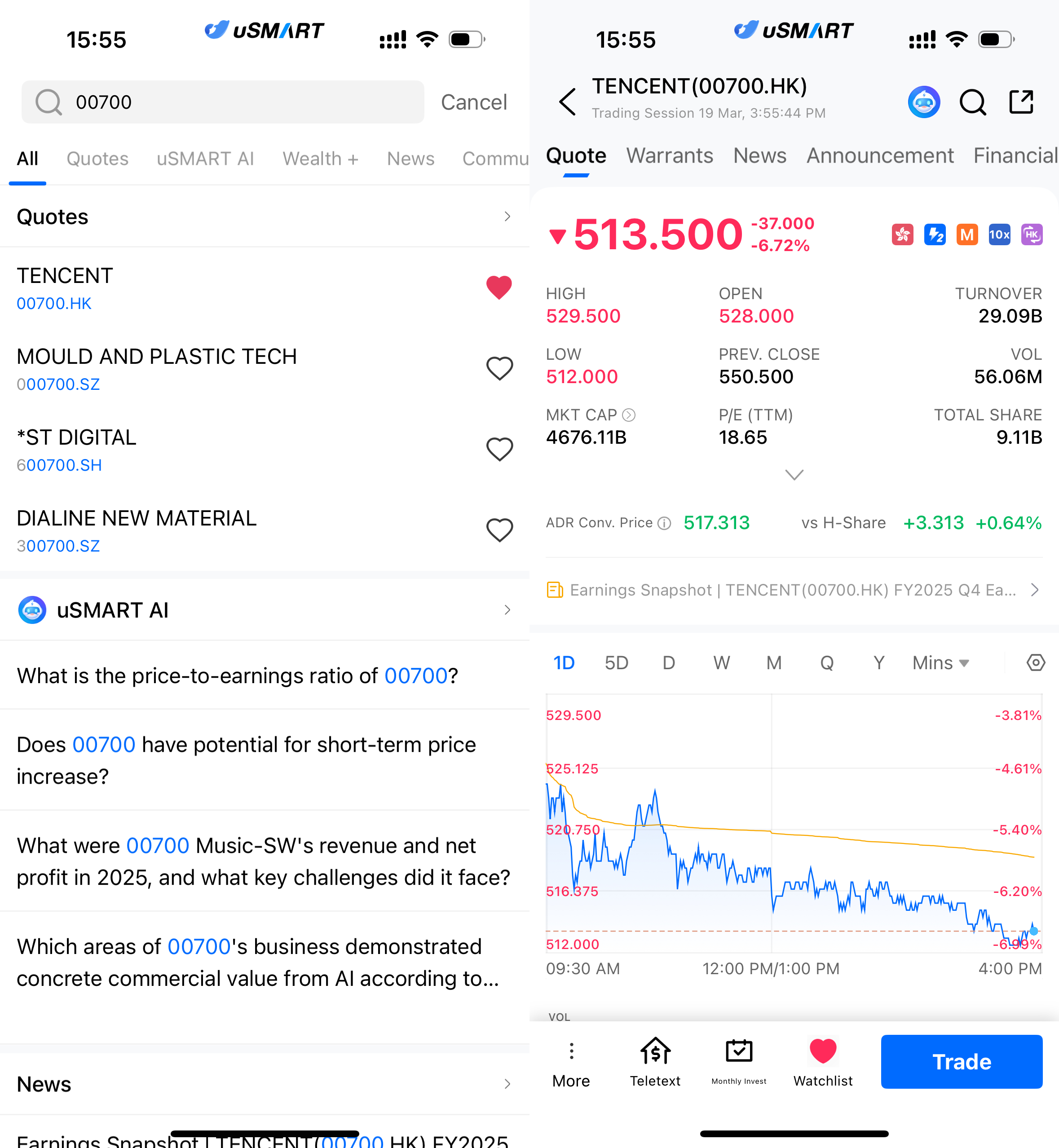
(Image Source: uSMART HK app)


More Content