Investment CoursesAlibaba Bets on “Agentic Shopping”: Qwen to Be Integrated into Taobao, Potentially Reshaping E-Commerce Search Logic
On May 10, Reuters reported that Alibaba Group plans to fully integrate its AI platform Qwen into Taobao and Tmall, launching an “Agentic Shopping” service. The news has once again intensified market attention on the commercialization of “AI + e-commerce.”
According to the report, consumers may no longer need to rely on traditional keyword searches or manually filter products on e-commerce platforms. Instead, they will be able to complete the entire shopping journey — from product discovery and price comparison to order placement and after-sales service — simply by interacting with an AI agent through natural conversation.
The integration is widely viewed as a major step in the commercialization of Alibaba’s AI strategy, and also signals that China’s internet platforms are transitioning from the “AI tools” stage to the era of “AI execution agents,” or AI Agents.
AI Is No Longer Just Chatting — It Is Beginning to “Complete Purchases” for Users
In the future, Qwen is expected to connect with Taobao and Tmall’s database of more than 4 billion products, while also gaining capabilities related to logistics coordination, after-sales support, and order management. The system will generate personalized recommendations based on users’ historical purchases, spending preferences, and browsing behavior.
This means AI is no longer limited to providing information; it is evolving into a “shopping assistant” or even a “consumer agent” capable of executing purchasing decisions.
For example, a user could simply type: “Help me find a lightweight suit suitable for summer business trips with a budget under RMB 1,500.” The AI would then automatically screen products, compare prices, analyze reviews, and even complete the purchase process. This model differs fundamentally from traditional e-commerce systems that rely heavily on keyword matching and advertising-driven search rankings.
Meanwhile, the Taobao app is also expected to launch an AI shopping assistant powered by Qwen, featuring functions such as virtual try-on and 30-day price trend tracking.
Why Is Alibaba Accelerating “Agentic Commerce”?
In reality, Alibaba has significantly accelerated its AI strategy over the past year. As early as 2023, the company launched the Qwen large language model and proposed a vision of integrating AI across all business segments. Since then, products including DingTalk, Taobao, and Quark have gradually incorporated Qwen’s capabilities.
This year, Alibaba has further strengthened its focus on AI Agents. Previous media reports indicated that the company has been exploring integrations between Qwen and ecosystem products such as Alipay, Amap, and Fliggy, aiming to build an integrated AI platform covering consumption, mobility, and payments.
From an industry perspective, “Agentic Commerce” is emerging as a new direction for AI commercialization. Unlike traditional chatbots, AI Agents emphasize the ability to execute tasks. In other words, AI is not merely answering questions — it can proactively invoke tools, perform operations, and handle complex workflows.
E-commerce is considered one of the most practical deployment scenarios for AI Agents because it already possesses a complete closed-loop infrastructure, including products, payments, logistics, and after-sales services.
Chinese E-Commerce Platforms May Be the First to Build a Full AI Commerce Loop
Reuters also noted that Chinese and U.S. e-commerce platforms are beginning to diverge in their AI commercialization strategies. Chinese platforms tend to embed AI deeply into real transaction workflows. Alibaba, for example, owns an integrated ecosystem spanning Taobao, Alipay, and Cainiao, enabling AI to directly participate in transaction execution.
In contrast, overseas platforms have adopted a relatively more cautious approach. Although Amazon has already introduced AI-powered recommendations and product summaries within its platform, it remains conservative regarding fully autonomous AI shopping agents. Meanwhile, Shopify currently focuses more on enabling third-party AI integrations rather than launching a unified proprietary AI consumer platform.
Industry observers believe that Chinese internet platforms may have an advantage in building AI-driven commercial ecosystems because years of development around “super apps” have already created highly integrated infrastructures for payments, logistics, and instant fulfillment services, making it easier to establish a complete AI commerce closed loop.
How to Buy Alibaba on uSMART
After logging into the uSMART HK app, click the “Search” button in the top-right corner of the page, enter the ticker code (BABA.US), and navigate to the details page to view transaction details and historical trends. Click the “Trade” button in the bottom-right corner, select the trade type, and submit your order after filling in the transaction conditions.
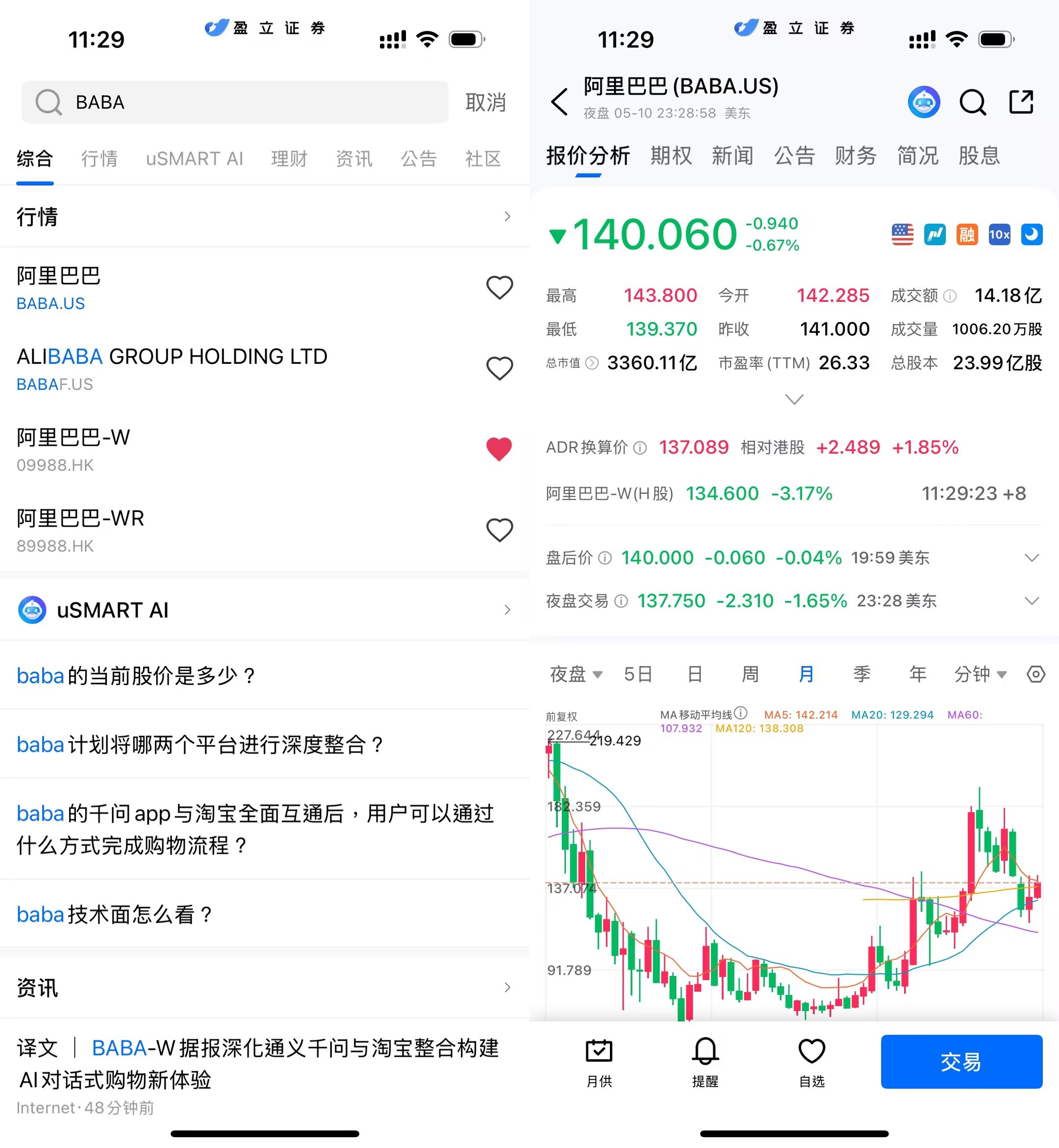
(Image Source: uSMART HK app)


More Content