Investment CoursesFigma Q1 Revenue Surges 46% as AI Products Drive Enterprise Expansion, Shares Jump Over 10% After Hours
On May 15, shares of U.S. design software company Figma (FIG.US) moved sharply higher in after-hours trading. According to the latest market data, Figma rose to $22.34, up approximately 10.46% after hours, after briefly reaching an intraday high of $24.33. Trading volume increased significantly as investors focused on the company’s stronger-than-expected first-quarter results.
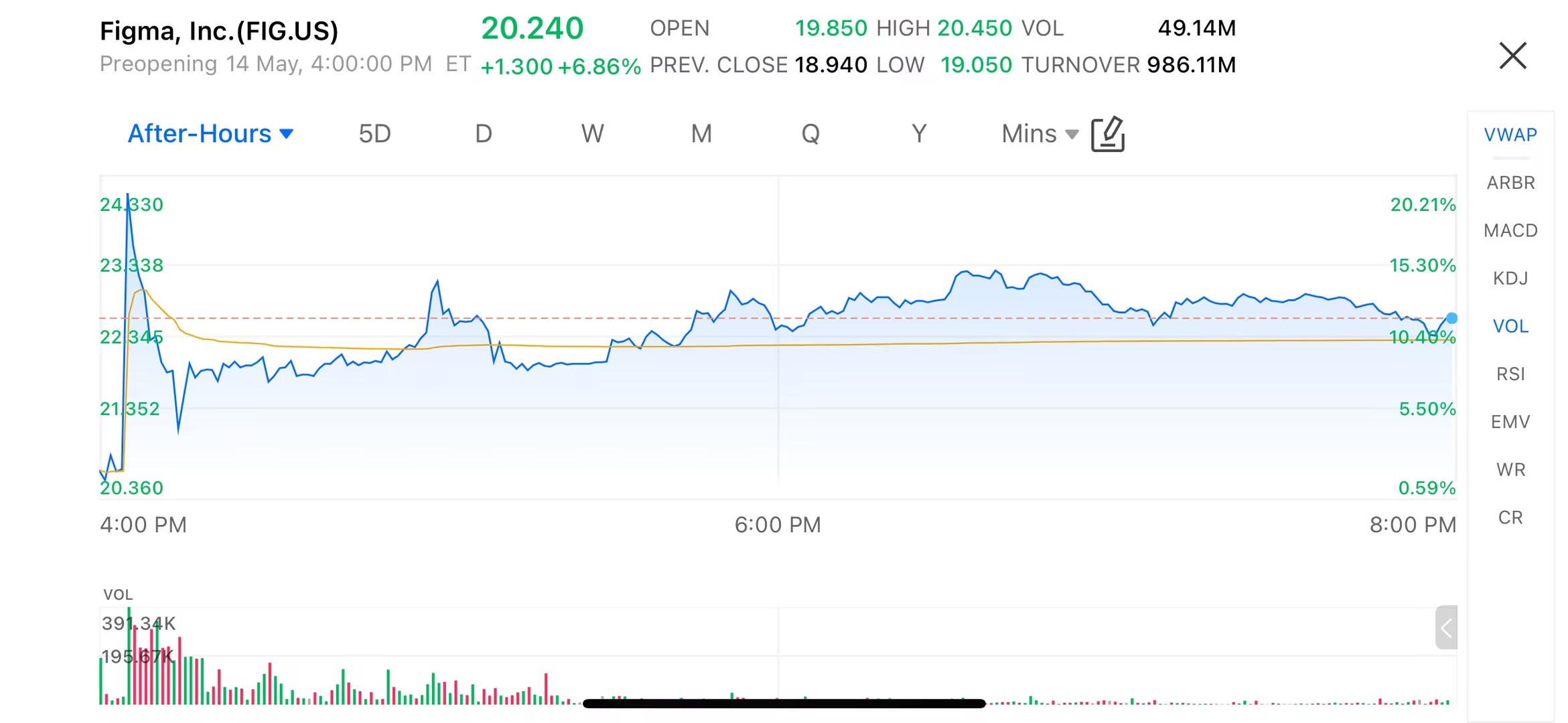
(Image Source: uSMART HK app)
Revenue Growth Accelerates for a Second Consecutive Quarter Amid Strong Enterprise Demand
According to the company’s earnings release, Figma generated revenue of $333 million in the first quarter of 2026, representing a 46% year-over-year increase. The result exceeded the company’s previous guidance range and marked a further acceleration from 40% growth in the fourth quarter of 2025 and 38% growth in the third quarter, highlighting continued strength in enterprise demand.
In terms of profitability, Figma reported a GAAP operating loss of $137.4 million, with a GAAP operating margin of negative 41%. On a non-GAAP basis, the company recorded operating income of $52.1 million, corresponding to a non-GAAP operating margin of 16%.
Meanwhile, free cash flow reached $88.6 million, representing a free cash flow margin of 27%, while net cash provided by operating activities totaled $97.3 million.
On the bottom line, Figma posted a GAAP net loss of $142.4 million, while non-GAAP net income came in at $56.5 million. GAAP net loss per share was $0.27, while non-GAAP diluted earnings per share reached $0.10, ahead of market expectations.
As of March 31, 2026, Figma held approximately $1.6 billion in cash, cash equivalents, and marketable securities, maintaining a solid balance sheet position.
Rising AI Adoption Prompts Management to Raise Full-Year Guidance
Management highlighted the company’s AI business momentum during the earnings release. Figma noted that enterprise seat expansion exceeded expectations, driven in part by increasing adoption of its AI-powered products, including Figma Make, MCP, and Figma Weave, which are being integrated more deeply into product design and collaborative development workflows.
Figma co-founder and CEO Dylan Field stated that as coding increasingly becomes commoditized, design is emerging as a key competitive differentiator for products. He added that customers are using Figma’s ecosystem of products and collaboration tools at an unprecedented scale.
Chief Financial Officer Praveer Melwani said that early commercialization progress for the company’s AI offerings had outperformed expectations, while the core platform continued to deliver strong growth, prompting management to raise full-year guidance.
Looking ahead, Figma expects second-quarter 2026 revenue to range between $348 million and $350 million, implying approximately 40% year-over-year growth at the midpoint.
For the full year, the company raised its 2026 revenue outlook to between $1.422 billion and $1.428 billion, representing 35% annual growth at the midpoint and an increase of approximately $55 million from its previous forecast. Figma also expects full-year non-GAAP operating income to range between $125 million and $135 million.
“Design + AI” Platform Narrative Gains Market Attention
As generative AI tools become increasingly embedded in software development and product design workflows, investors are reassessing the long-term value of collaborative design platforms.
Compared with traditional UI design software, Figma is evolving toward a broader “design + collaboration + AI generation” platform model. Its AI-assisted prototyping, automated interface generation, and team collaboration capabilities are increasingly viewed by the market as key long-term growth drivers.
How to Buy Figma on uSMART
After logging into the uSMART HK app, click the “Search” button in the top-right corner of the page, enter the ticker code (FIG.US) , and navigate to the details page to view transaction details and historical trends. Click the “Trade” button in the bottom-right corner, select the trade type, and submit your order after filling in the transaction conditions.
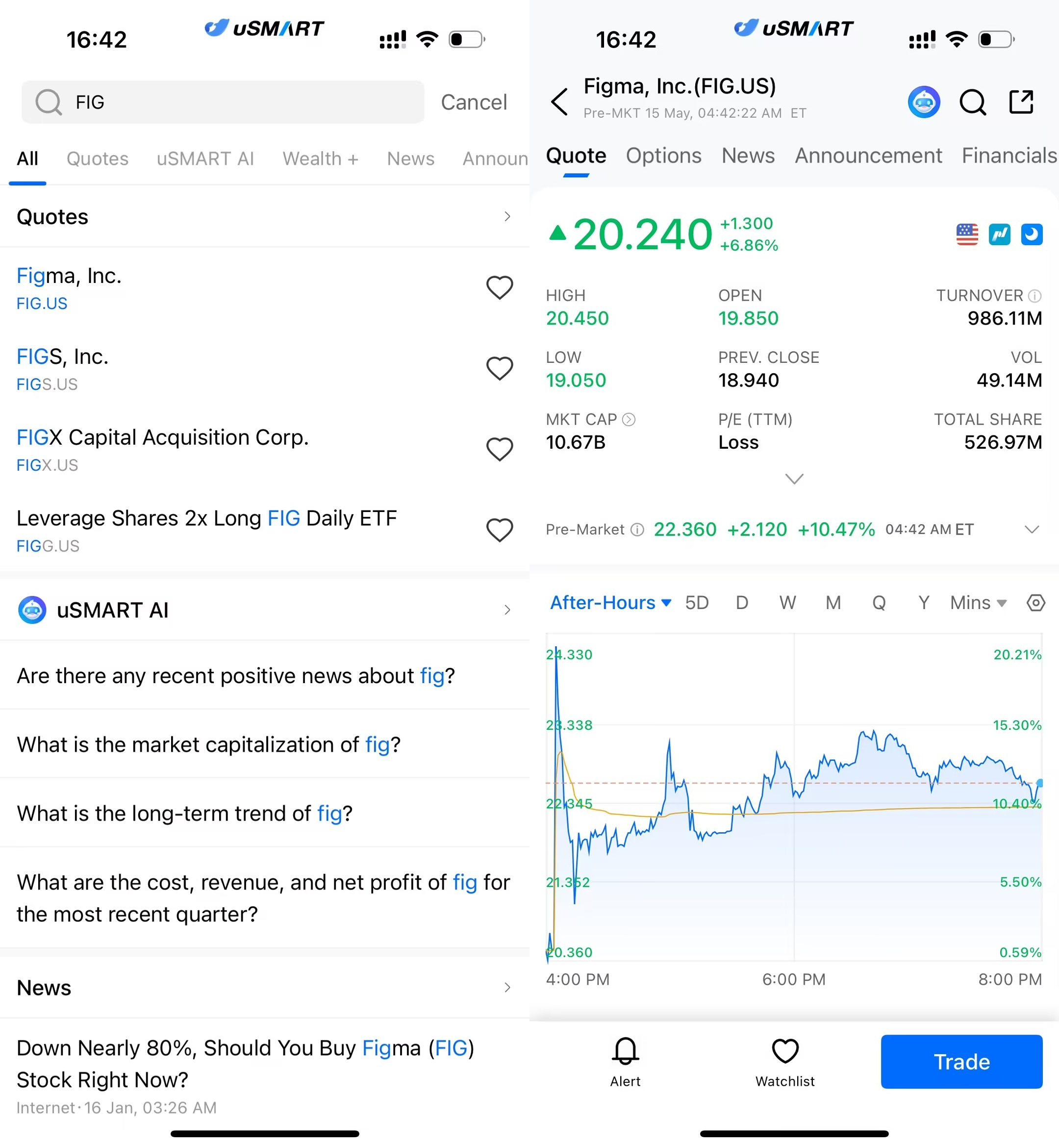
(Image Source: uSMART HK app)


More Content