Investment CoursesPCB Stocks Rally Broadly as Kingboard Holdings Surges Nearly 25%, Soaring Electronic Glass Fiber Cloth Prices Fuel Industry-Wide Price Hike Expectations
On June 9, Hong Kong-listed PCB and copper-clad laminate (CCL) stocks staged a broad-based rally. As of publication, Kingboard Holdings (00148.HK) surged 24.81%, while Kingboard Laminates (01888.HK) gained 12.78%, Victory Giant Technology (02476.HK) rose 12.88%, and Guanghe Technology (01989.HK) advanced 15.34%. Supported by continued increases in electronic glass fiber cloth prices, rapidly growing AI server demand, and tightening supply of high-end materials, sentiment toward the PCB supply chain has strengthened significantly.
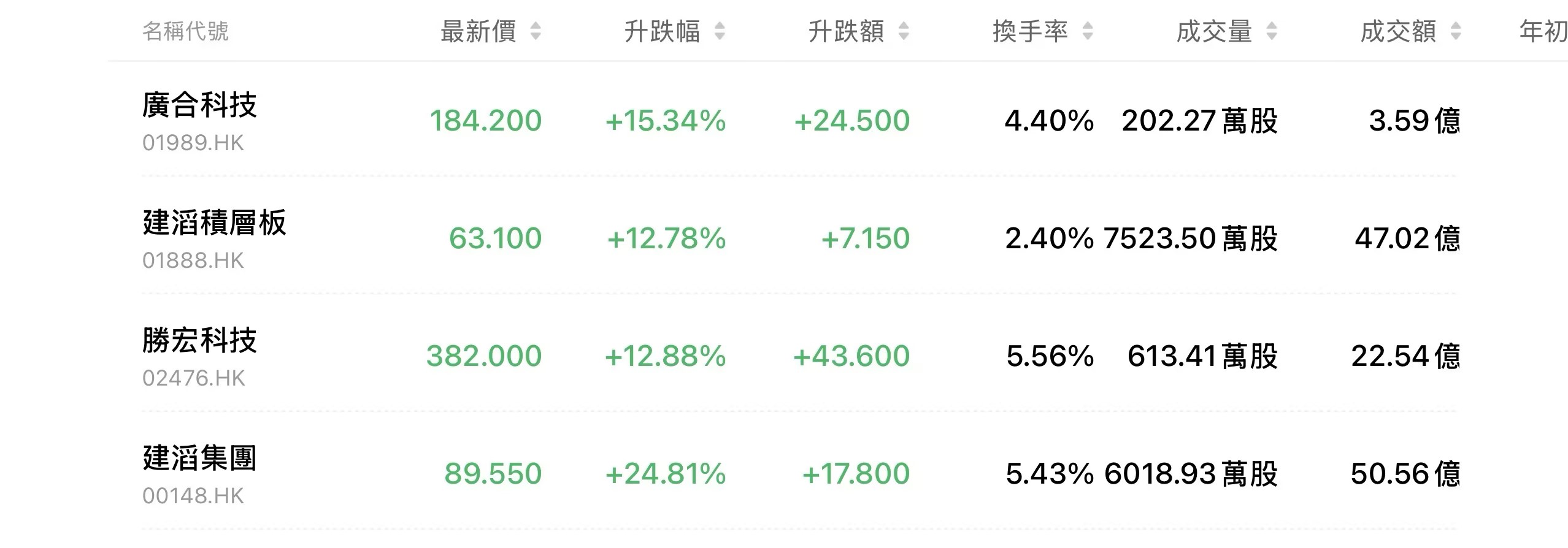
(Image source: uSMART HK App)
Electronic Glass Fiber Cloth Prices Double from Lows After Five Rounds of Increases This Year
One of the most closely watched developments in the PCB industry recently has been the sharp rise in electronic-grade glass fiber cloth prices. According to China Central Television (CCTV) Finance, the market has undergone five consecutive rounds of price increases since the beginning of the year. As of early June, the average market price for mainstream electronic glass fiber cloth products had climbed to approximately RMB 7.4 per meter, representing a cumulative increase of around 100% from the lows recorded in the third quarter of last year and reaching the highest level in recent years.
Electronic glass fiber cloth is a key raw material used in the production of copper-clad laminates, which in turn serve as the fundamental substrate for PCB manufacturing. As glass fiber cloth prices continue to rise, cost pressures are increasingly being transmitted along the supply chain. Market participants generally expect CCL manufacturers to implement a new round of price hikes, which could improve profitability across the broader PCB industry.
Unlike previous pricing cycles that were primarily driven by supply-side contraction, the current upcycle is being supported more meaningfully by sustained demand growth.
AI Server Boom Drives Strong Demand for High-End PCBs
As the artificial intelligence industry enters a period of rapid expansion, global technology companies continue to invest aggressively in AI infrastructure. The mass production of NVIDIA’s Blackwell platform, together with ongoing AI data center expansion by Microsoft, Amazon, Google, and Meta, is significantly boosting demand for high-performance PCBs.
Compared with traditional servers, AI servers require a greater number of GPUs, high-speed networking chips, and advanced communication equipment, resulting in substantially higher demand for high-layer-count PCBs, high-speed copper-clad laminates, and HDI (High-Density Interconnect) boards. The PCB value content per AI server is therefore considerably higher than that of conventional servers.
According to industry research, the PCB value of AI servers is typically several times greater than that of traditional servers. Demand for high-performance PCBs used in high-speed switches and advanced computing clusters continues to expand, supporting a sustained improvement in industry fundamentals. Several leading PCB manufacturers have reportedly secured order visibility extending into the second half of the year, with AI-related business becoming an increasingly important contributor to revenue growth.
Tightening PPE Resin Supply Adds Upward Pressure on High-End Material Prices
In addition to robust demand conditions, new supply-side disruptions have emerged in upstream raw materials. Market reports indicate that the Saudi Arabian industrial hub of Jubail previously accounted for approximately 70% of global PPE resin production capacity. Ongoing geopolitical tensions in the Middle East and disruptions to logistics networks have raised concerns about potential supply shortages of this critical material.
PPE resin is a key component used in the production of high-frequency and high-speed copper-clad laminates and is widely applied in AI servers, data center switches, 5G communication equipment, and automotive electronics.
Industry analysts believe that if PPE resin supply recovery progresses more slowly than expected, prices of high-end CCL products could rise further, enhancing the pricing power of related manufacturers. Meanwhile, copper foil and epoxy resin prices have remained elevated, reinforcing market expectations of a broader pricing upcycle across the PCB supply chain.
Institutions Turn More Positive on CCL Leaders as the Industry Undergoes Re-Rating
In response to rising raw material costs, several financial institutions have begun revising upward their earnings forecasts for PCB and copper-clad laminate companies. Citi noted that recent increases in electronic glass fiber cloth prices have significantly exceeded market expectations and are likely to be reflected in CCL product pricing as early as the end of this month. As industry inventories continue to normalize, leading manufacturers are expected to benefit first from the price pass-through effect.
From a supply-chain perspective, CCL producers generally possess strong cost-transfer capabilities. When upstream raw material prices increase, these companies are often able to pass on higher costs through product price adjustments, thereby preserving profitability. Under strong demand conditions, some firms may even achieve margin expansion.
The recent rally in PCB-related stocks appears to be supported by more than short-term market sentiment. Instead, it reflects a combination of structural drivers, including accelerating AI computing demand, improving industry supply-demand dynamics, and the transmission of raw material price increases throughout the value chain.
As demand for AI servers, high-speed switches, and advanced packaging technologies continues to grow, the PCB industry may be entering a new cyclical upturn. The earnings leverage and valuation re-rating potential of leading companies are likely to remain key areas of focus for investors.


More Content