Investment CoursesNvidia Q1 Revenue Surges 85% YoY as Data Center Business Hits Another Record High; Company Authorizes Additional $80 Billion Share Repurchase
On May 21, AI chip leader NVIDIA reported financial results for the first quarter of fiscal year 2027 ended April 26, 2026. Driven by continued strong demand for AI data center infrastructure, the company once again delivered record-high revenue, earnings, and data center sales.
As of Wednesday’s U.S. market close, NVIDIA (NVDA.US) rose 1.30%. Following the earnings release, the stock fluctuated in after-hours trading, at one point falling more than 3% before trimming losses.
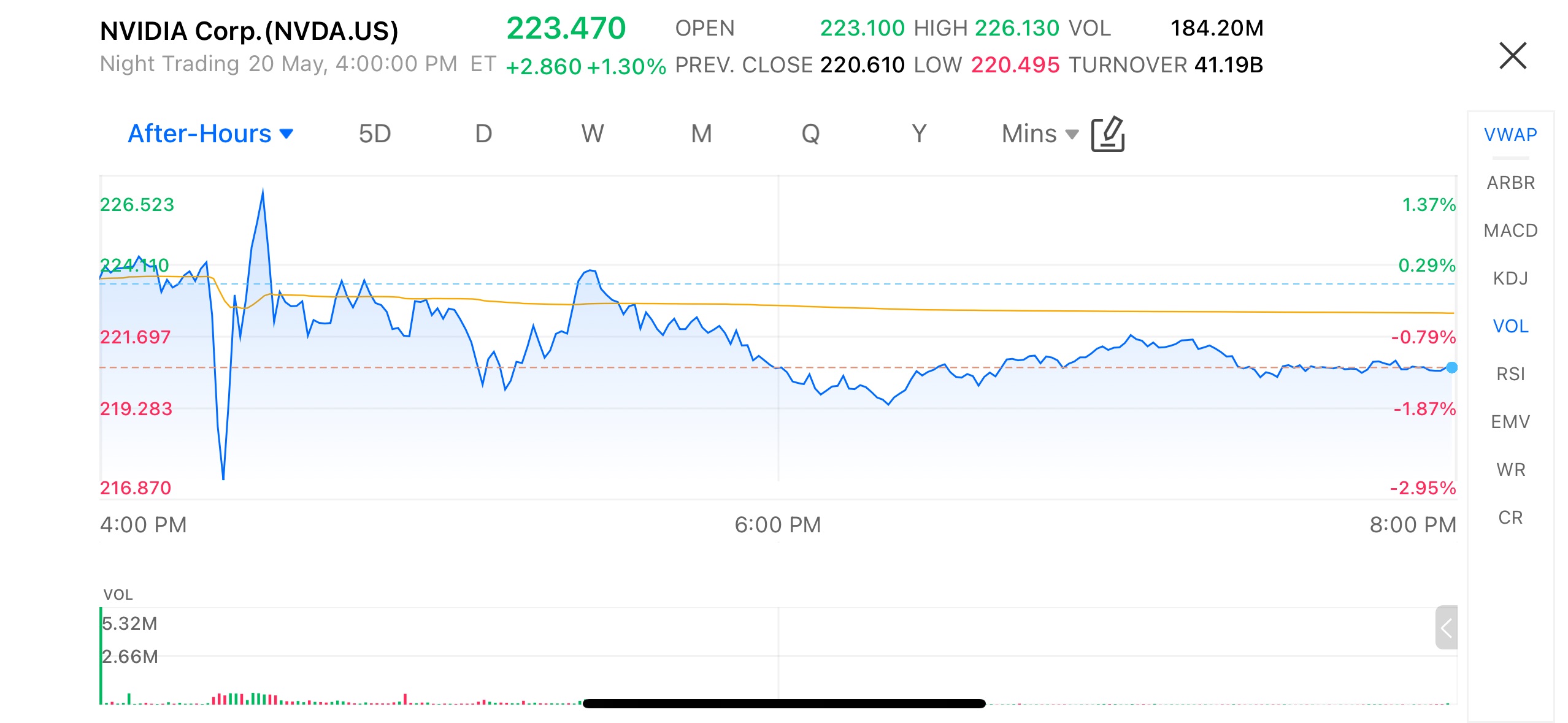
(Image Source: uSMART HK app)
Quarterly Revenue Exceeds US$80 Billion; Data Center Revenue Accounts for More Than 90% of Total Sales
According to the earnings report, NVIDIA generated revenue of US$81.62 billion in the first quarter, up 85% year-over-year, marking the company’s fastest revenue growth rate in more than a year and extending its record streak for quarterly revenue.
On the profitability side, non-GAAP diluted earnings per share (EPS) reached US$1.87, representing a 140% year-over-year increase. Earnings growth significantly outpaced revenue growth, highlighting the strong operating leverage of NVIDIA’s AI business.
Among all segments, the closely watched data center business posted revenue of US$75.2 billion, up 92% year-over-year, accounting for approximately 92% of total company revenue. This indicates that the vast majority of NVIDIA’s current revenue is now generated from AI-related data center operations, with AI computing demand remaining the company’s primary growth engine.
Notably, data center networking revenue surged 199% year-over-year to US$14.8 billion, setting another all-time high and reflecting rapidly growing demand for AI clusters, high-speed interconnect solutions, and large-scale GPU server deployments.
Meanwhile, NVIDIA’s non-GAAP gross margin remained at a very high 75.0%, far above the level typically seen across the semiconductor industry, underscoring the company’s strong pricing power across AI GPUs, the CUDA software ecosystem, and its supply chain infrastructure.
Q2 Guidance Expected to Reach Another Record High; China Business Not Included in Forecast
Looking ahead to the second quarter, NVIDIA expects revenue of approximately US$91 billion, plus or minus 2%, which would set another company record and exceed current market consensus expectations.
The company specifically noted that the guidance does not include any revenue contribution from data center computing business in China. Amid ongoing export restrictions and geopolitical uncertainties, this suggests that NVIDIA’s current growth outlook is being driven primarily by demand outside the Chinese market.
In addition, NVIDIA’s board of directors approved an additional US$80 billion share repurchase authorization and raised the quarterly dividend from US$0.01 per share to US$0.25 per share, representing a 24-fold increase, reflecting the company’s strong cash flow generation and robust profitability.
NVIDIA Fiscal 2027 Q1 Key Financial Metrics
|
Metric |
Q1 Results |
YoY Change |
Market Expectations |
Notes |
|
Revenue |
US$81.62 billion |
+85% |
Approx. US$79.19 billion |
Record high |
|
Adjusted EPS (Non-GAAP) |
US$1.87 |
+140% |
Approx. US$1.76 |
Beat expectations |
|
Non-GAAP Gross Margin |
75.0% |
+14.2 ppt |
74.5% |
Remained elevated |
|
Data Center Revenue |
US$75.2 billion |
+92% |
Approx. US$73.48 billion |
Approximately 92% of total revenue |
|
Data Center Compute Revenue |
US$60.4 billion |
+77% |
Approx. US$61.1 billion |
Slightly below expectations |
|
Data Center Networking Revenue |
US$14.8 billion |
+199% |
— |
Record high |
|
Q2 Revenue Guidance |
US$91 billion ±2% |
— |
Approx. US$87 billion |
Excludes China data center compute revenue |
|
Share Repurchase |
Additional US$80 billion |
— |
— |
Enhanced shareholder returns |
|
Quarterly Dividend |
US$0.25 per share |
24x increase |
— |
Payable on June 26 |
Source: NVIDIA earnings report, company filings, Bloomberg, FactSet, and publicly available market data.
New Reporting Structure May Prompt Markets to Reassess NVIDIA’s AI Valuation Framework
In this earnings release, NVIDIA also announced a new business disclosure framework. Going forward, the company will primarily report operations under two major segments: “Data Center Platforms” and “Edge Computing Platforms.”
The data center platform segment will be further divided into hyperscale cloud customers and enterprise AI markets, while the edge computing platform segment will include AI PCs, robotics, automotive, and AI-RAN businesses.
The restructuring signals NVIDIA’s continued transition from a GPU chip supplier into a broader AI infrastructure and ecosystem platform company spanning AI factories and physical AI applications. However, as the revised reporting structure may affect historical comparability, it could also create short-term challenges for investors attempting to reassess the company’s business mix and valuation framework.
How to Buy NVIDIA on uSMART
After logging into the uSMART HK app, click the “Search” button in the top-right corner of the page, enter the ticker code (NVDA.US), and navigate to the details page to view transaction details and historical trends. Click the “Trade” button in the bottom-right corner, select the trade type, and submit your order after filling in the transaction conditions.

(Image Source: uSMART HK app)


More Content