Under the influence of factors such as monetary policy and geopolitical conflicts, the US dollar and US bond yields have been consistently rising, showing strong momentum. As of April 15th, the yield on the 10-year US Treasury bond reached above 4.5%, hitting new highs for the year. At the same time, the US dollar index approached the 106 level, reaching its highest level since November of last year.
In addition to the impact of monetary policy expectations on the market, the situation in the Middle East over the past weekend also affected market sentiment. However, as various parties called for restraint and to avoid an escalation of the Middle East conflict, market concerns have somewhat eased. Although the US dollar index retraced slightly on April 15th, US bond yields continue to rise steadily. Does this signify the arrival of a crisis or does it conceal opportunities?
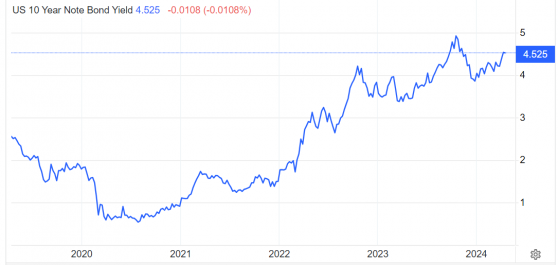
(Data Source: Investing.com)
(Data cut-off date: April 15, 2024.)
Reasons and Impact of the Surge in US Bond Yields
US bond yields refer to the interest income generated by US government bonds. The US government issues bonds as a means of borrowing to raise funds to meet its fiscal needs. When investors purchase US government bonds, they provide funds to the government, and in return, the government pays a certain interest to the investors.
- Reasons for the Surge in US Bond Yields
The recent surge in the US dollar and bond yields is driven by changes in monetary policy expectations, which are influenced by several key factors:
- Monetary Policy Expectations
The monetary policy of the Federal Reserve System (Fed) has a significant impact on US bond yields. In the first quarter, US inflation data consistently outperformed expectations, indicating higher inflation in the first half of the year than anticipated by the market. This has led to a notable cooling of expectations for interest rate cuts by the Fed, with delayed timing, smaller rate cuts, and higher terminal interest rates.
- Economic Recovery and Inflation Expectations
Recent major economic indicators in the US, such as employment data and CPI, as well as high-frequency data like manufacturing PMI and consumer confidence index, all point to the resilience of the US economic fundamentals. Confidence in the economic fundamentals has driven the upward trend in the yield of 10-year Treasury bonds. US economic data shows a rebound in economic activity, coupled with the impact of fiscal stimulus measures, leading to increased market expectations of inflation. Higher inflation expectations lead investors to demand higher interest rates to offset inflation risks, thereby pushing up bond yields.
- Geopolitical Risks
Geopolitical tensions often trigger market risk aversion, driving investors to purchase safe-haven assets such as US bonds. The recent escalation of geopolitical conflicts in the Middle East has increased the demand for safe-haven assets and consequently boosted the performance of the US dollar index. However, the impact of geopolitical conflicts remains relatively limited, and many investors are still in a wait-and-see mode.
- Impact on Global Financial Markets:
- Capital Outflows from Emerging Markets
When US bond yields rise, the increased return on US bonds attracts global investors to shift funds from other assets to the US bond market. This can lead to capital outflows from emerging markets, exacerbating pressure on their currencies and stock markets, potentially causing currency depreciation and stock market declines. Risk assets may be impacted, while fixed-income assets may benefit.
- Global Stock Market Adjustments
The rise in US bond yields can trigger adjustments in global stock markets. Higher bond yields make the bond market more attractive, potentially causing investors to shift funds from the stock market. Additionally, higher interest rates can negatively impact stock markets, particularly for heavily indebted companies facing increased financing costs.
- Currency Market Volatility
An increase in US bond yields often leads to a stronger US dollar as higher interest rates make US dollar assets more attractive. This can have implications for global currency markets, especially for countries with a higher dependency on the US dollar. Other currencies may face depreciation pressures, particularly when they are confronted with economic or political challenges.
- Bond Market Adjustments
The rise in bond yields can trigger adjustments in global bond markets. Bond prices have an inverse relationship with yields, meaning that when yields rise, bond prices decline. Therefore, bonds held by investors may face capital losses. This can impact fixed-income investors, including institutional investors and pension funds.
- Impact on Global Financial Stability
US bonds, as one of the most important safe-haven assets in global financial markets, experience volatile yield fluctuations that can lead to instability in global financial markets. Investors may reassess the balance between risk and return, resulting in portfolio reallocations that can trigger market volatility and uncertainty.
Possibility of Crisis:
- Debt Burden
High yields can pose a greater burden on highly indebted companies, governments, and individuals. When debt serviceability is challenged, high interest rates can increase default risks and trigger financial crises.
- Global Economic Slowdown
The surge in US bond yields may reflect market concerns about a slowdown in economic growth. If global economic growth is severely impacted, with declining corporate profits and rising unemployment rates, it can lead to instability in the financial system and trigger systemic crises.
- Currency Market Volatility
When US bond yields rise, it can trigger volatility in global currency markets. This can lead to currency depreciation in emerging markets, which in turn can cause capital outflows and financial market turmoil, posing systemic risks to emerging markets. For example, in the 2013 "Taper Tantrum," the US announced a reduction in quantitative easing, leading to capital outflows from emerging markets and significant pressure on their currencies and stock markets. Emerging markets need to enhance economic resilience, including improving economic structures, increasing foreign exchange reserves, and reducing external debt.
- Market Sentiment Swings
The significant fluctuations in US bond yields can trigger intense swings in market sentiment. Rapid changes in investor sentiment can lead to overreactions and increased market volatility, potentially causing instability in financial markets. Investors need to remain calm and rational, avoiding blind herding and excessive speculation, while strengthening risk management and diversification of investments.
- Monetary Policy Mistakes
If central banks make policy mistakes that result in interest rates rising too quickly or to excessively high levels, it can have adverse effects on the economy. Excessively high rates can increase financing costs for businesses, reduce investments, and dampen consumption, potentially triggering financial crises.
Hidden Opportunities and Prospects
The surge in US bond yields is associated with potential opportunities in the following aspects:
Investment Return Growth: High-yielding US bonds may attract investors seeking higher returns. Particularly for investors looking for relatively safe income, high-yielding US bonds can be an attractive investment option.
Increased Safe-Haven Demand: When markets face uncertainty and heightened risks, investors often seek safe-haven assets, including US bonds. Therefore, the rise in US bond yields can potentially trigger an increase in demand for safe-haven assets, driving investors to allocate funds to relatively secure assets.
Based on the mentioned opportunities, here are possible investment opportunities and strategies:
- Optimize Asset Allocation
Investors can optimize their asset allocation by allocating a portion of funds to US bonds with stable returns. This helps reduce overall portfolio risk and provides relatively stable returns.
- Identify Undervalued Assets
High-yielding US bonds may lead to adjustments and opportunities in certain markets. Investors can look for undervalued assets, such as stocks, bonds, or other financial products. During periods of market sentiment volatility, some high-quality assets may be overlooked, so discovering and investing in these undervalued assets can yield returns.
- Diversify Investment Portfolio
In an environment of uncertainty and potential market volatility, diversifying the investment portfolio remains an important strategy. Investors can mitigate risk and seek better returns by diversifying funds across different asset classes, industries, and regions.
- Explore Other Safe-Haven Assets
Apart from US bonds, there are other safe-haven assets to consider, such as gold, safe-haven currencies (such as the Swiss franc and Japanese yen), and stable blue-chip stocks. These assets may perform well during market turmoil and can be part of the investment portfolio.


More Content