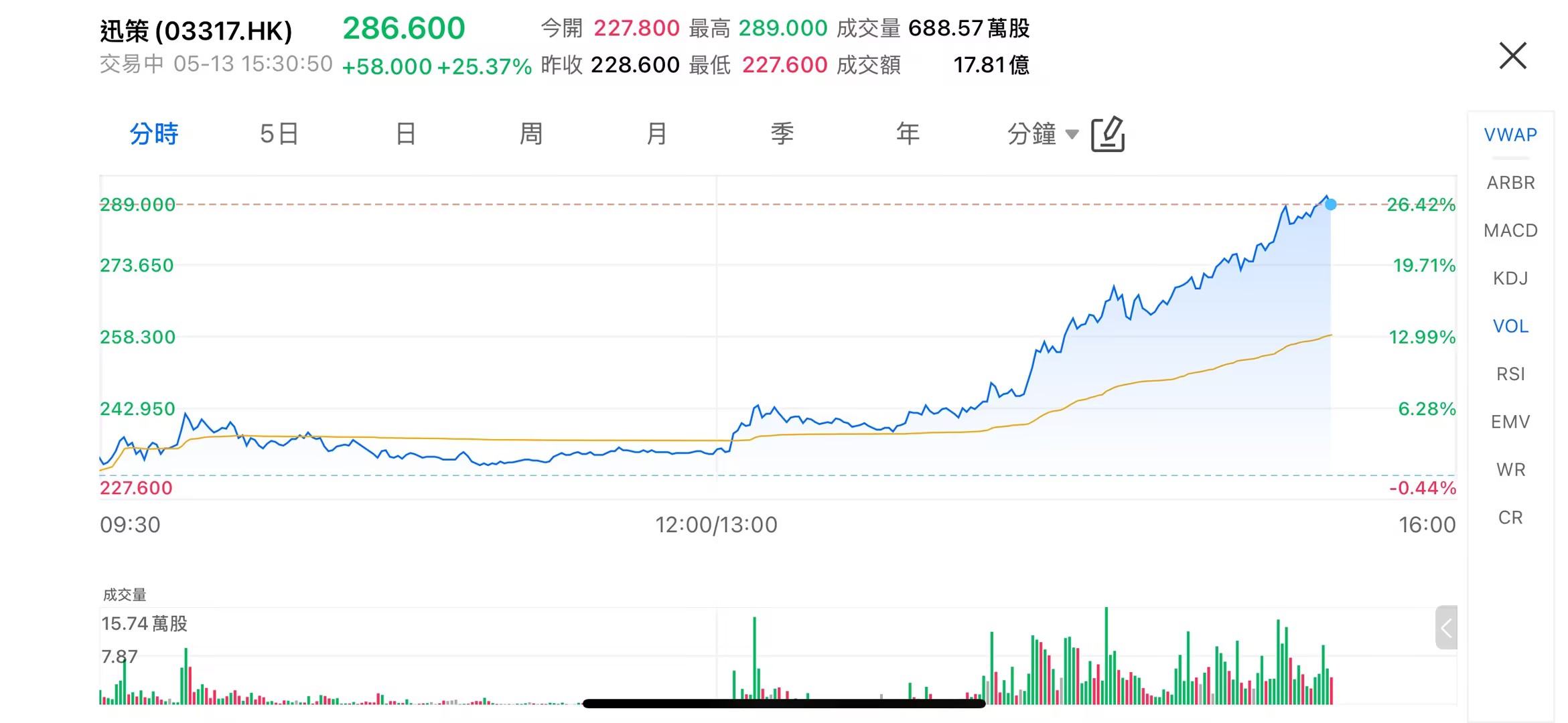
On May 13, Hong Kong-listed AI application stocks remained active, with Xunce (03317.HK) posting particularly strong gains during the session. As of publication, the company’s shares were trading at HK$286, up 25.37%, with turnover reaching approximately HK$1.781 billion. The stock also hit a new recent high intraday, reflecting rising market attention and strong capital inflows.
(Image Source: uSMART HK app)
Explosive Growth in Token Demand Signals the Arrival of the “Inference Era”
Market sentiment was boosted by the accelerating adoption of Agentic AI, which has significantly increased investor focus on AI inference demand and Token monetization capabilities. Industry observers believe the AI sector is gradually shifting from a “training-driven” phase toward an “inference-driven” phase, with Token consumption emerging as a key indicator of AI commercialization.
Public data shows that China’s average daily Token consumption stood at around 100 billion in early 2024, but exceeded 140 quadrillion by March 2026, representing growth of more than 1,000 times within two years. As AI models continue to penetrate industries including office productivity, e-commerce, marketing, finance, and customer service, the growing complexity of user interactions has sharply increased demand for model inference.
Compared with traditional AI chatbots, Agentic AI systems are capable of task decomposition, tool invocation, workflow execution, and dynamic decision-making. As a result, their Token consumption is substantially higher than that of standard question-and-answer applications. The market generally expects AI agents to become one of the primary drivers behind the next wave of explosive Token demand growth.
Industry Focus Shifts Toward Commercialization of AI Inference
Recently, multiple institutions have begun reassessing valuation frameworks across the AI value chain. Market focus is no longer centered solely on model parameters and training capabilities, but increasingly on commercialization and monetization potential following real-world deployment.
In a recent report, Morgan Stanley stated that China’s AI industry is transitioning from “catching up technologically” to “capturing commercial value.” The industry’s focus is shifting from training expansion toward inference applications, and from technological competition toward profitability and monetization.
Against this backdrop, valuation logic for AI inference-related companies is also evolving. Companies capable of generating high-frequency Token usage, establishing recurring revenue streams, and deploying enterprise-grade AI applications are increasingly attracting investor re-rating.
Market participants believe that future AI revenue growth may depend less on the models themselves and more on which companies can build high-value, high-retention AI application ecosystems.
ARR Surges 300% Quarter-on-Quarter as Token Revenue Contribution Expands
Business metrics recently disclosed by Xunce have also become a major market focus.
According to company data, Token-call annual recurring revenue (ARR) surged approximately 300% quarter-on-quarter in April 2026, highlighting rapid growth in its AI inference-related business. Meanwhile, Token-based paid revenue has exceeded 5% of total revenue, with the company targeting an increase to 20%–30% for the full year.
The market believes this indicates that Xunce’s AI business is gradually moving from the investment phase into the monetization phase, with its commercialization pathway becoming increasingly clear.
At the same time, the company’s premium pricing power in vertical AI Token applications is viewed as another core competitive advantage.
Currently, pricing for some of Xunce’s vertical-domain Token products has reached US$10 to US$100 per million Tokens, significantly above pricing levels for general-purpose AI models. Certain high-value application scenarios are reportedly priced several times higher than comparable overseas products, reflecting growing willingness among enterprise clients to pay for specialized AI capabilities.
Enterprise AI Adoption Accelerates as High-Value Scenarios Gain Traction
From an industry perspective, enterprise-focused Agentic AI is increasingly emerging as a key direction for AI commercialization.
Compared with consumer-facing chatbot applications, enterprise AI solutions place greater emphasis on workflow automation, integration with professional knowledge bases, and execution of complex tasks. As a result, enterprise customers generally demonstrate stronger payment capabilities and higher long-term retention rates.
Currently, industries including finance, legal services, healthcare, industrial manufacturing, and enterprise productivity are rapidly accelerating deployment of AI agent applications. Industry observers widely expect demand for high-value Tokens to continue rising as enterprises increasingly integrate AI into core business workflows.
From a capital market perspective, investor preference within Hong Kong’s AI sector has also begun to shift noticeably. Compared with earlier concept-driven rallies, the market is now placing greater emphasis on companies with tangible revenue growth, commercialization progress, and improving profitability.
As AI agent penetration continues to rise, Token economics, inference computing power, and AI application monetization are likely to remain key themes for the market going forward.
How to Buy Xunce on uSMART
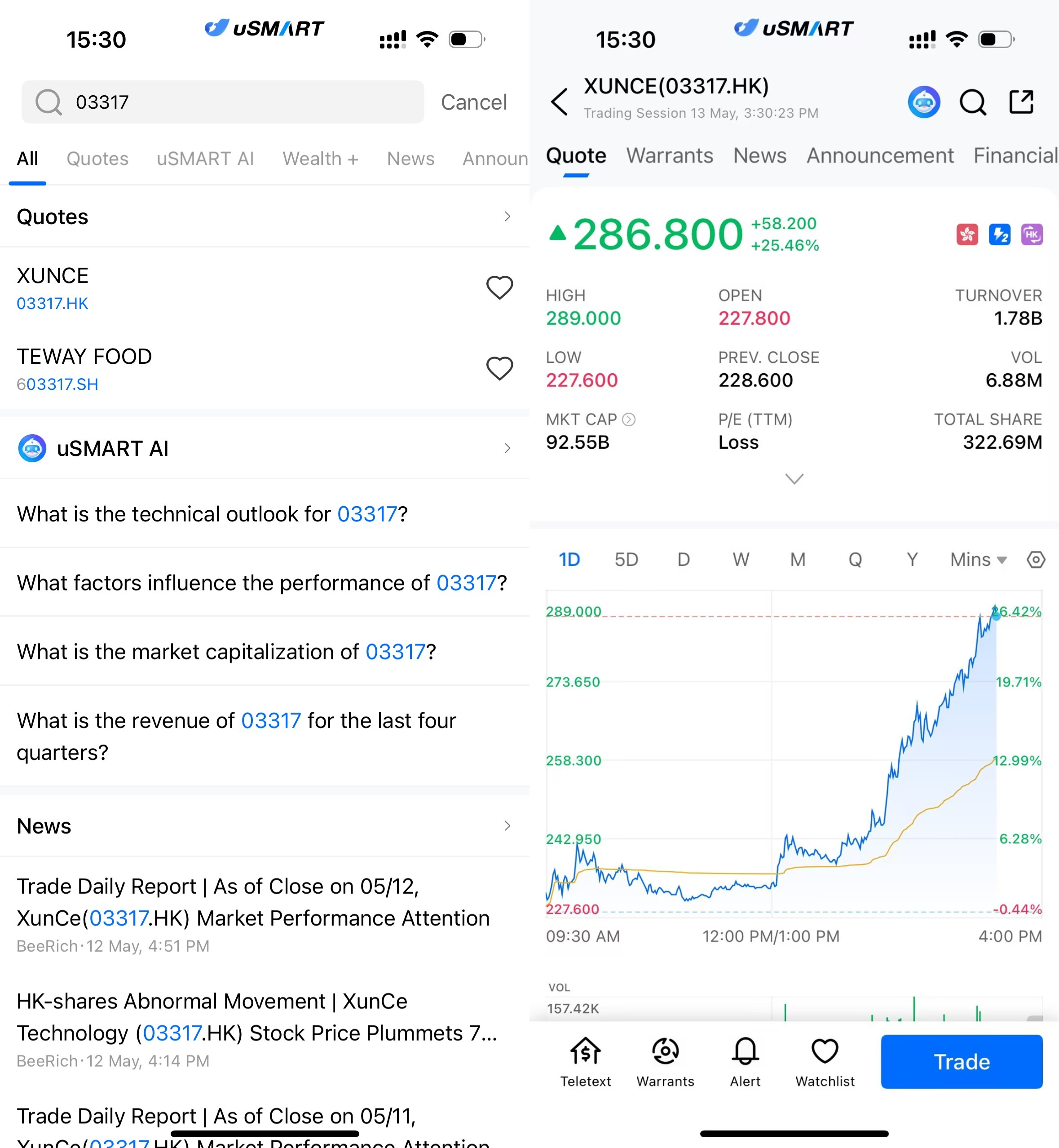
After logging into the uSMART HK app, click the “Search” button in the top-right corner of the page, enter the ticker code (03317.HK), and navigate to the details page to view transaction details and historical trends. Click the “Trade” button in the bottom-right corner, select the trade type, and submit your order after filling in the transaction conditions.
(Image Source: uSMART HK app)


More Content