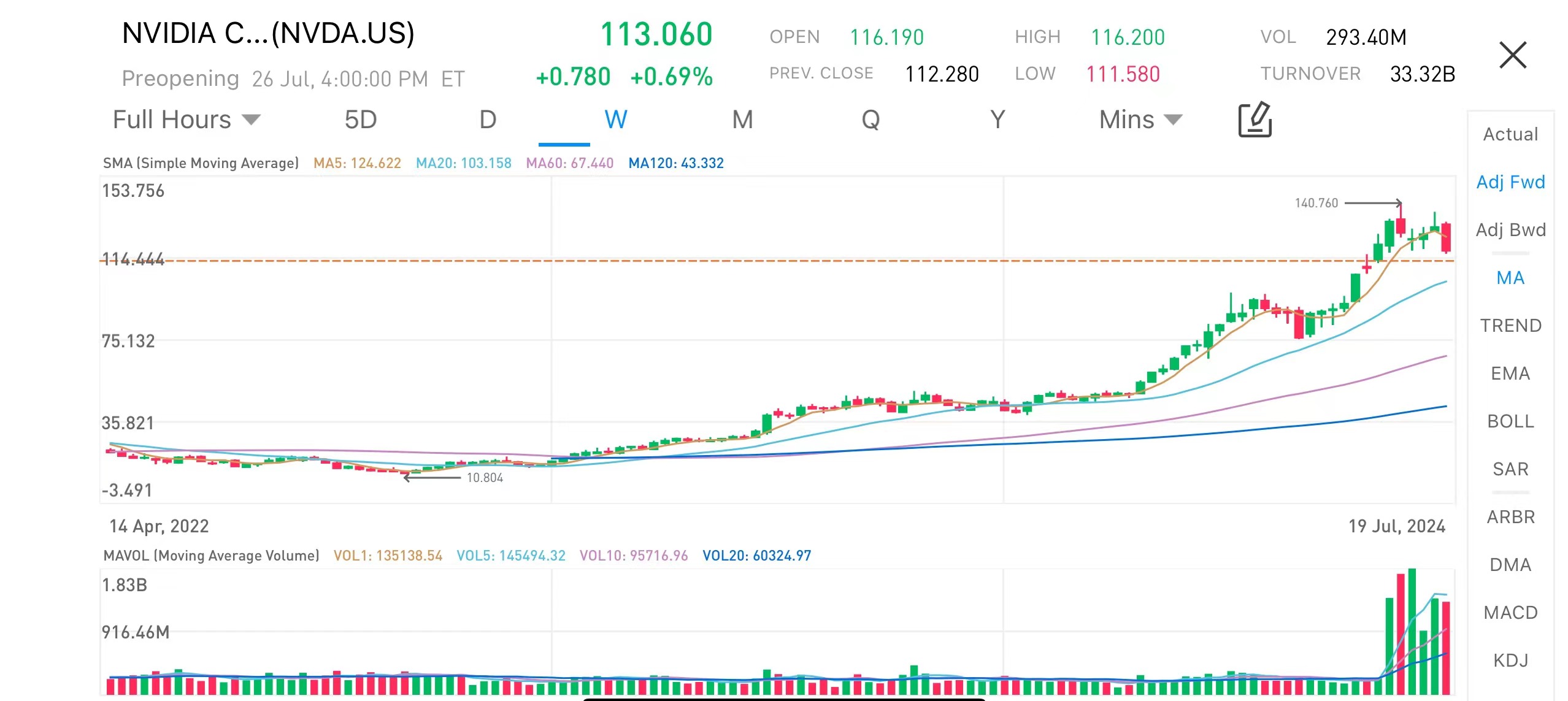
Since the launch of ChatGPT, a chatbot software developed by OpenAI, at the end of 2022, the share price of AI chip stock king Nvidia (NVDA.US) has risen sevenfold, driving a rebound in U.S. stocks dominated by large-cap stocks.
(Source: uSMART)
Expansion of AI technology is driving growth in other industries
Stock markets are experiencing significant sector rotation as global investor concerns over the profitability of technology giants grow, geopolitical tensions persist and global monetary policy becomes looser. Investors are pulling money out of large-cap AI tech stocks and investing in smaller stocks and defensive stocks.
This rotation coincides with the expansion of the AI topic beyond chips and software, including the vast amounts of power and land required for AI technology, and the potential industries that may ultimately benefit from putting AI into practical applications.
Gina Martin Adams, chief equity strategist at Bloomberg Intelligence, said that she has seen the emergence of other AI-related transactions outside of the technology and communications fields.
While the technology and communications industries still dominate the market, the expansion of AI technology is driving growth in other industries. Optimism about utility stocks increased in the second quarter on the belief that AI will attract more investment and ultimately lead to stronger growth.
Power stocks: AI and mining power consumption surges
With the rapid development of artificial intelligence (AI), an inevitable problem has surfaced: the operation of AI systems requires a large amount of energy, especially electricity. It is estimated that ChatGPT, a chatbot owned by OpenAI, consumes more than 500,000 kilowatt-hours of electricity every day, which is equivalent to 17,000 times the daily electricity consumption of an American household.
Tech giants represented by Tesla founder Musk and OpenAI CEO Altman have warned about the energy crisis facing the AI industry, believing that "a new energy crisis is coming." Experts predict that the power consumption of global AI systems may soon be equivalent to the annual power generation of a medium-sized European country.
The tech industry’s surge in electricity demand exceeds available supplies in many parts of the world. The International Energy Agency (IEA) estimates that electricity consumption by data centers, AI and cryptocurrencies will double to 1,000 terawatt hours by 2026, equivalent to the electricity consumption of all of Japan. The surge in power demand from AI technology has made global utility stocks the focus of investors, especially hydropower and new energy concept stocks.
Utility stocks around the world may be in focus, including Dominion Energy and Southern Co. in the United States, YTL Power and Gulf Energy Development in Southeast Asia.
Evgenia Molotova, senior investment manager at Pictet Asset Management, believes that the widespread application of AI may change the rules of the game in the power industry.
Electrical equipment stocks: supply exceeds demand
Computing loads such as generative AI have driven a significant increase in the power density of data centers, increasing the quantity and performance requirements for corresponding power equipment. Electrical equipment such as transformers and switch cabinets are widely used in data centers. According to Eaton's forecast, the market space for electrical equipment driven by data centers is expected to grow by 16% from 2022 to 2025.
According to EIA statistics, the installed capacity of various large-scale (above 1MW) generators in the United States will be 40.5GW in 2023, a year-on-year increase of 27.8%. The CAGR from 2019 to 2023 will be 13.8%, among which photovoltaic and energy storage growth rates are relatively high. As of the end of 2023, the scale of various large-scale power generation projects under construction in the United States is 53.2GW, and the scale of planned projects is as high as 165.7GW. It is expected to be mainly put into operation in the next three years, and there is broad room for long-term growth.
Ken Liu, China utilities analyst at UBS Group AG, said there is a very short supply of transformers that help deliver power from generators to users. The order is placed today and it will not arrive until 2028 at the earliest. Therefore, top transformer manufacturers will face a situation of short supply, which will benefit related power equipment stocks.
New energy stocks: wind power and hydrogen energy are favored
The development of AI has caused a sharp increase in electricity consumption and raised concerns about increasing pollution. Investors are increasingly paying attention to renewable energy stocks. Companies involved in solar (photovoltaic), hydropower, wind power and nuclear power generation are all seen as potential beneficiaries of AI. Wind power and hydrogen energy concept stocks have gained favor from the market due to their potential in the field of green energy.
Although China's solar panel industry (photovoltaic industry) faces challenges from U.S. and European tariffs, hydropower concept stocks such as Yangtze Power (600600.SH) and Sichuan Investment Energy (600674.SH) may still attract investors' attention.
Copper: key material for cables
AI is even driving commodity trade, with copper a key material in cables and heat exchangers, a piece of equipment that cools data centers. Related positive resource stocks include: Freeport-McMoRan Copper and Gold (Freeport-McMoRan), BHP Billiton (BHP) and Jiangxi Copper (00358.HK). Bloomberg Intelligence analyst Grant Sporre said that global copper consumption may increase by 2 million tons by 2030, with more than half of the demand coming from the United States.
Data centers: increased demand for land and facilities
As an important infrastructure for the application of AI technology, data centers have increasing demand for land and facilities. This has brought new investment opportunities to real estate investment trusts (REITs) that specialize in data centers such as Equinix, Digital Realty and Singapore's Keppel DC REIT.
The share price of Australian real estate company Goodman Group has risen by about 35% this year. In addition, Southeast Asia is regarded as an emerging AI hotspot, and companies such as Telekom Malaysia and Thailand's AIS Communications (AIS) also regard data centers as new growth engines.
Opportunities in the Industrial and Healthcare Sectors
Some market strategists focus on companies that profit from implementing AI technology to improve their businesses, known as "adopters."
Morgan Stanley estimates that adopter share prices will rise an average of 27% this year as productivity improvements help boost their performance. The bank also sees industrial stocks as one of the sectors that will benefit the most.
The widespread application of AI technology will significantly improve productivity, thus improving the performance of related companies. Medium- and heavy-duty truck manufacturer Paccar (PCAR.US) and agricultural equipment manufacturer John Deer (DE.US) are using AI technology to optimize production and business processes.
AI technology is also seen as a boon to the healthcare industry, especially helping to speed up the drug development process. Scott Schoenhaus, healthcare technology analyst at KeyBanc Capital Markets, recommends several smaller biotech stocks based on this view, such as:
Recursion Pharmaceuticals
Schrödinger, Inc.
The wide application of AI technology not only promotes the development of technology and communication fields, but also brings new investment opportunities to multiple industries such as power, new energy, resources, real estate, industry and medical health. Investors should pay attention to these industry sectors that benefit from the growth in demand for AI to capture the potential gains brought about by market rotation.


More Content